Eucalyptus in Georgia: An Introduced Tree That Went Wild
Every other plant in the BioGroup catalog is a native Caucasus species gathered in the mountains of Samtskhe-Javakheti. Eucalyptus is the exception, and we would rather say so plainly than quietly imply otherwise. Eucalyptus viminalis is Australian. It reached Georgia’s Black Sea coast in the late nineteenth and early twentieth century, planted in the humid Colchis lowlands as part of the same wave of eucalypt planting used across the Caucasus and elsewhere to drain marshland and reduce mosquito habitat in the fight against malaria (Eucalyptus, overview; Colchis Lowland).
More than a century later, those stands have naturalized. They grow wild, unmanaged, unsprayed, in a warm and wet coastal lowland — and they are the source of Eucalyptus (Botanical Monograph No. 61, Specimen 08), supplied as dried leaf, whole or cut.
Below: the botany, the volatile-oil chemistry, an unusually important regulatory section, industrial applications, safety, and the quality framework a buyer should apply.
Botanical Identity & Why This Species Survives in Georgia
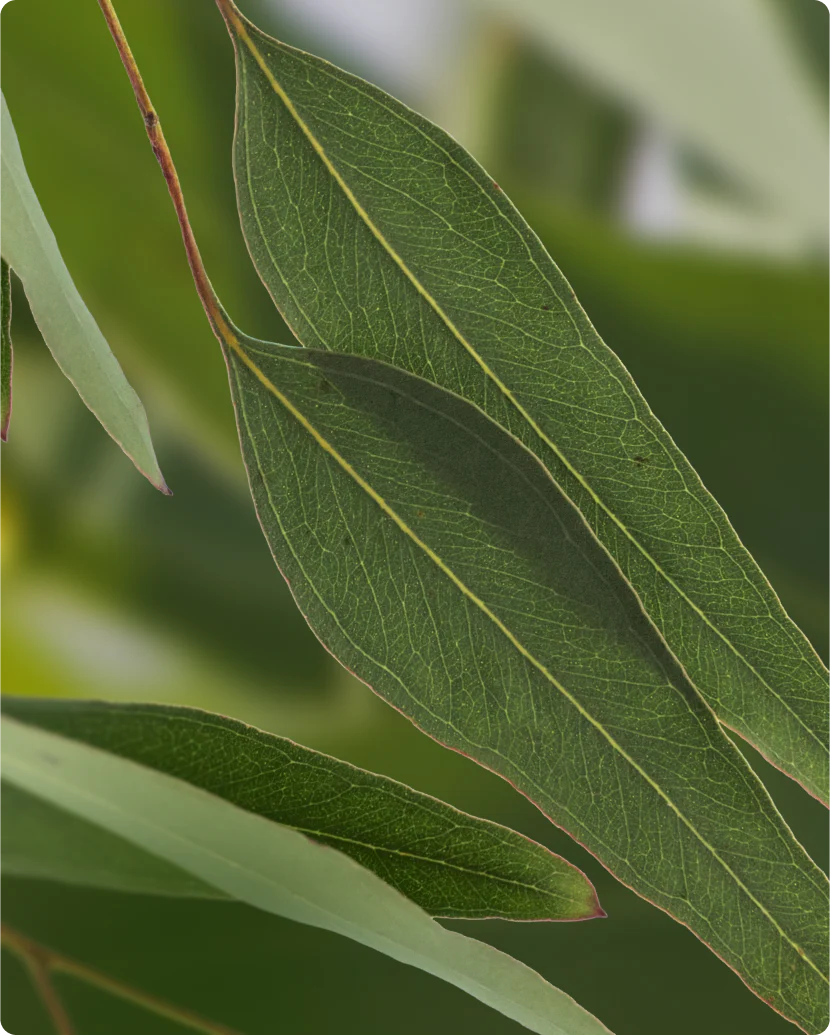
The source is Eucalyptus viminalis Labill. (Myrtaceae), known in the trade as Manna Gum, Ribbon Gum, or White Gum. The part used is the leaf, supplied whole or cut.
Two facts explain why this particular eucalypt, and not a more famous one, is what grows wild in Georgia:
- E. viminalis is among the more cold-hardy eucalypts. It entered European cultivation before 1885, and while most eucalypts planted in that era succumbed to frost, viminalis is rated as comparatively hardy — one account puts its tolerance in the region of −15 °C to −20 °C (Trees and Shrubs Online; Useful Temperate Plants). On a coast with occasional hard winters, hardiness is what decided which species is still standing.
- The Colchis lowland climate suits it. Warm, humid, high-rainfall, near sea level — a subtropical pocket unlike anywhere else in Georgia, and the same zone that historically supported the country’s tea and citrus.
Because eucalyptus is evergreen, it is also the only material in our catalog with a year-round harvest window. Everything else we supply is bound to a narrow seasonal cut; eucalyptus leaf is not. For buyers running continuous production, that is a supply-planning advantage worth noting.
Phytochemistry: A Cineole-Bearing Leaf, With Caveats
The pharmacologically interesting fraction is the essential oil, dominated in cineole-type eucalypts by 1,8-cineole (eucalyptol).
A GC/MS analysis of E. viminalis leaf oil identified 66 compounds, with the major constituents reported as:
- 1,8-cineole (eucalyptol): 57.8%
- α-pinene: 13.4%
- Limonene: 5.4%
- Aromadendrene: 3.9%
- Globulol: 3.1%
- Alloaromadendrene: 2.0%, α-gurjunene: 1.4%
(Essential oil composition of Eucalyptus microtheca and Eucalyptus viminalis, PMC; PubMed record)
Read that figure with care, and we would rather you did. That analysis was performed on material collected in Sistan and Baluchestan, Iran, by hydrodistillation. Eucalyptus essential oil composition is strongly variable with species, provenance, season, and growing environment — variation shaped by genetic and environmental factors that produce real geographic structure in the chemistry (Chemical Variability and Biological Activities of Eucalyptus spp. Essential Oils, PMC).
A published cineole percentage from Iranian material is literature context, not a specification for Georgian leaf. BioGroup does not publish a cineole figure for our material that we have not measured. What we will do is arrange independent third-party analysis of oil content and composition on request — which, for a volatile-oil crop with known chemotypic variability, is the only honest way to sell it.
Beyond the volatile fraction, the leaf carries flavonoids and tannins, contributing to the astringent and antioxidant character of aqueous preparations.
Regulatory Position: Read This Before You Write Your Specification
This section matters more for E. viminalis than for almost any other botanical we supply, because the pharmacopoeial articles for “eucalyptus” are species-specific and do not cover it.
- European Pharmacopoeia — Eucalyptus leaf (Eucalypti folium) is defined as the whole or cut dried leaves of older branches of Eucalyptus globulus Labill., with a minimum essential oil content of 20 mL/kg for the whole drug and 15 mL/kg for the cut drug (EMA assessment documentation).
- EMA/HMPC — Eucalyptus oil (Eucalypti aetheroleum) covers the essential oil obtained from E. globulus, E. polybractea, and E. smithii (EMA herbal medicine page).
- E. viminalis appears in neither.
What is generalisable is the pharmacological rationale. The German Commission E reported secretomotory, expectorant, mildly antispasmodic, and mild local hyperaemic activity for cineole-rich Eucalyptus species, and approved eucalyptus internally for catarrh of the respiratory tract and externally for rheumatic complaints. The traditional leaf-infusion preparation is 2–3 g of chopped leaf in 150 mL of water, twice daily (PeaceHealth monograph summary).
The correct commercial positioning, therefore: E. viminalis leaf is a cineole-bearing eucalyptus leaf traded on its own identity — suitable as a botanical raw material, a tea and cosmetic ingredient, and a feedstock for distillation. It is not a drop-in substitute for pharmacopoeial Eucalypti folium, and it should never be declared as one. A buyer who needs Ph. Eur.-compliant E. globulus leaf needs E. globulus. A buyer who needs an aromatic, cineole-bearing eucalyptus leaf from a clean, unsprayed wild source, correctly declared as E. viminalis, is exactly who this material is for.
That distinction is the same one we draw for blackberry leaf, which sits under the German Commission E rather than an EMA monograph — knowing precisely which standard a botanical falls under is what makes a supply chain auditable.
Applications by Industry
Pharmaceutical & Respiratory
Dried leaf for traditional respiratory-support preparations — expectorant and decongestant formulations, inhalation blends, and chest-rub extracts — and as feedstock for essential oil distillation. Positioning should rest on the species as declared, with lot-specific oil analysis where the cineole level is material to the formulation.
Cosmetic
Aromatic, cineole-bearing leaf for soaps, balms, bath products, and essential-oil-based skincare, where the fresh camphoraceous character is the point. As with nettle seed, one caveat is worth stating: the established INCI entries in the cosmetic dictionaries are built on E. globulus, so confirm the correct declaration for a viminalis-derived ingredient with your own regulatory team before committing to artwork.
Nutraceutical & Herbal Tea
Cut leaf for herbal tea blends and aromatic infusions traditionally taken to support easy breathing. Eucalyptus is a strong, dominant note — in blending practice it works at low inclusion rates against milder carriers, and pairs naturally with the softer respiratory botanicals in our range.
Safety & Handling
Eucalyptus is one of the few botanicals we supply where the concentrated form is genuinely hazardous, and buyers who distil or concentrate need to know it:
- Eucalyptus oil is acutely toxic when ingested. As little as 3.5 mL taken internally has proven fatal (PeaceHealth). The dried leaf is not the hazard; the oil someone makes from it can be.
- Do not apply cineole-rich preparations to the face or nose of infants and small children — risk of laryngospasm.
- Comminuted leaf preparations are for adults and children over 12; alcoholic tinctures, for adults only.
- Contraindications: inflammatory gastrointestinal or biliary tract disease, and severe liver disease.
- Drug interactions: cineole induces hepatic enzyme systems and may weaken or shorten the action of some medications — the Commission E monograph names pentobarbital, aminopyrine, and amphetamine as examples. Any formulation intended for regular use should be reviewed on this basis.
- Storage: volatile oil is the value. Keep cool, dark, and sealed; oil content declines with heat, light, and time in open storage.
Quality & Sourcing from Georgia’s Black Sea Coast
Our eucalyptus leaf is hand-cut from wild, naturalized stands in the coastal lowlands of western Georgia — away from the southern mountains where the rest of our range is gathered — then shade-dried to protect the aromatic oil, sorted, and packed whole or cut. The trees grow wild, without spraying or chemical treatment. Our general approach to drying volatile-oil-bearing material is described in how we wild-harvest and dry medicinal plants.
As with our whole catalog, we state the limits: BioGroup does not yet operate its own laboratory and does not issue its own Certificate of Analysis. We provide traceability to the harvest area and export documentation (phytosanitary certificate, certificate of origin), and third-party laboratory analysis can be arranged on request. For a volatile-oil crop, the specification a buyer should build is:
- Essential oil content, by the Ph. Eur. 2.8.12 method for determination of essential oils in herbal drugs — the single most important number for this material
- 1,8-cineole content by GC, lot-specific, given the documented chemotypic variability
- Loss on drying / moisture, foreign matter and stem content, total ash
- Heavy metals (typical specification limits: lead ≤ 5.0, cadmium ≤ 1.0, mercury ≤ 0.1 ppm)
- Pesticide residues and microbial limits (WHO oral-use guidance: total aerobic bacteria 10⁵ CFU/g, Enterobacteria 10³ CFU/g, E. coli / Salmonella absent)
The Georgian case for this material is specific rather than romantic: century-old naturalized stands that receive no agricultural inputs at all, a year-round harvest window that most eucalyptus origins can match but most seasonal wild-harvest suppliers cannot, and a short, transparent chain from the coast to the container. For the wider regional picture, see why source medicinal herbs from Georgia and our overview of the medicinal plants of Georgia.
Partner with BioGroup
Eucalyptus joins Hypericum, Helichrysum, Rosa canina, Urtica, Nettle Seed, Taraxacum, and Blackberry Leaf in a transparent, direct-from-harvester Georgian supply chain. We supply dried leaf, whole or cut, traceable to the harvest area.
Explore our full product range, see specifications on the Eucalyptus viminalis product page, or contact us to discuss volumes, specifications, and sampling.