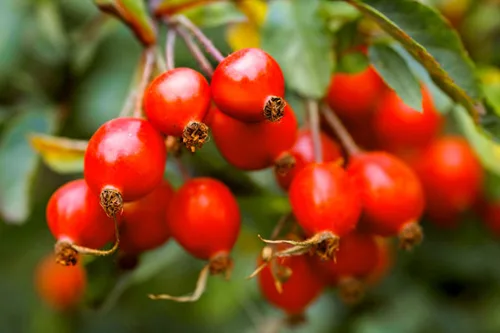
What Is Rosehip (Rosa Canina)?
The rosehip is the fruit of the wild dog rose, Rosa canina. After the pale-pink flowers fade, the plant forms bright red-orange “hips” — botanically an accessory fruit holding the seeds and the surrounding flesh that buyers prize. In the Caucasus, dog rose grows wild along forest edges and mountain slopes, and the hips are gathered in autumn when they are fully coloured.
Phytochemistry: More Than Vitamin C
Rosehip is best known as one of nature’s richest plant sources of vitamin C, but the full profile is broader:
- Vitamin C (ascorbic acid) — concentrated in the flesh of the hip
- Carotenoids — including beta-carotene and lycopene, which give the hips their colour and add antioxidant value
- Polyphenols and flavonoids — supporting overall antioxidant activity
- Pectin — a soluble fibre that gives rosehip preparations their body
- GOPO (a galactolipid) — derived largely from the seeds, and the focus of much of the modern joint-comfort research
Why Drying Temperature Matters
Vitamin C is heat-sensitive and degrades when fruit is dried too hot or too slowly. This is the single biggest quality variable in dried rosehip: careful, low-temperature drying retains far more of the ascorbic acid and colour than aggressive kiln-drying. When you evaluate a rosehip supplier, drying method is the question that matters most.
Research-Noted Joint Uses
Standardised rosehip powder — including the seed-derived GOPO component — has been studied for joint comfort and mobility, and is a well-known ingredient in the supplement market. As always, we present this as research-noted, not as a medical claim from us; finished-product makers should rely on their own substantiation.
Rosehip Tea: How to Brew
Rosehip makes a tart, fruity, ruby-coloured infusion. Use cut & sifted hips or crushed whole hips, steep in just-boiled water for 10–15 minutes, and strain well — the fine internal hairs around the seeds should be filtered out, which is why “seedless shells” and well-sifted cuts are popular for tea. The flavour pairs naturally with hibiscus and other tart, colourful botanicals in fruit-tea blends.
Cosmetic & Skincare Uses
A point of frequent confusion: rosehip (the dried fruit) and rosehip-seed oil are different products. The dried hips and their extracts are used for their vitamin C and antioxidant content in cosmetic formulation, while rosehip-seed oil is a pressed oil from the seeds. We supply the dried fruit raw material, not the pressed oil.
Rosa Canina vs Rosa Rugosa
Buyers sometimes receive Rosa rugosa hips in place of Rosa canina. The two are both used commercially but differ in size, shape, seed-to-flesh ratio and origin. Our material is wild Rosa canina from the Georgian Caucasus, and we are explicit about species on every order.
Wild-Harvest & Drying in Georgia
BioGroup hand-gathers rosehips from wild dog rose in Samtskhe-Javakheti in autumn, typically after the first frosts soften the fruit, then dries them at low temperature to protect vitamin C and colour. The same care we apply across the catalogue is described in how we wild-harvest and dry medicinal plants.
Forms & Sourcing
We supply wild Rosa canina as whole dried hips, cut & sifted, seedless shells, and powder — pesticide-free, with phytosanitary and origin documentation, and third-party lab testing arrangeable on request.
See the Rosa Canina product page for specifications, explore the full catalogue, or contact us for a sample and a quote.